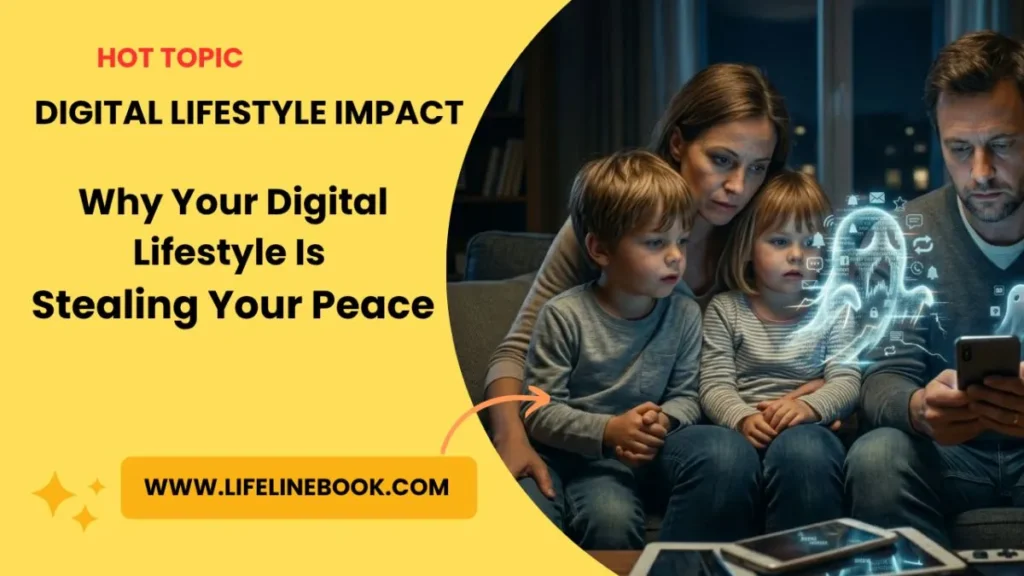
Howdy, friend. Have you ever sat down to watch a quick three-minute video and realized (Digital Lifestyle Impact), two hours later, that you’re looking at a tutorial on how to build a log cabin in the woods? You aren’t alone. In 2025 and 2026, we’ve hit a weird turning point. Our phones aren’t just tools anymore; they’re like tiny, glowing roommates that never shut up.
The buzzword on everyone’s lips lately is Digital Lifestyle Impact. Folks are waking up and realizing that the constant pings, the AI-generated “perfect” images, and the endless scroll are doing a number on our heads. It’s not just about being “distracted” anymore. It’s about how we think, how we remember, and how we feel when the screen goes dark.
If you’ve been feeling a bit “fuzzy” lately, or if your temper is shorter than a summer shadow, pull up a chair. We’re going to talk about what’s really happening behind that glass screen and how to get your brain back.
Why Can’t I Focus Anymore?
Let’s be honest: our attention spans are shrinking faster than a cheap wool sweater in a hot dryer. Recent studies in 2026 show the average person switches their attention on a screen every 47 seconds. That’s not a lifestyle; that’s a frantic game of mental musical chairs.
When we talk about Digital Lifestyle Impact, the first victim is always focus. Social media platforms are designed to give you a tiny hit of dopamine every time you see something new. Your brain gets addicted to that “newness,” making boring—but important—tasks like reading a book or finishing a report feel like pulling teeth.
The scary part? AI tools are making this even more intense. Generative AI can whip up content that is so perfectly tailored to your interests that you don’t even want to look away. It’s like a personalized fishing lure for your mind.
The Myth of Multitasking
We like to think we’re being productive by having fifteen tabs open while listening to a podcast. But the truth is, the human brain doesn’t multitask; it just switches gears really fast. Each time you switch, you pay a “switching cost.” It takes about 23 minutes to get back into a deep flow after one tiny interruption.
Imagine how much time we’re losing every single day. If you’re constantly checking your AI mental health impact, you’re never giving your brain the chance to actually finish a thought. This fragmentation is why you feel busy all day but end up with nothing done by sundown.
Is My Memory Fading, or Is It Just the Phone?
Have you ever gone to Google something, got distracted by a notification, and then forgot what you were looking for in the first place? That’s “Digital Amnesia.” Because we know our phones can remember everything—from birthdays to grocery lists—our brains have started to offload the heavy lifting.
The Digital Lifestyle Impact on memory is real. When we rely on AI to summarize articles or write our emails, we aren’t “encoding” that information into our long-term memory. We’re just skimming the surface.

The “Google Effect” in 2026
Psychologists call this the “Google Effect.” We are becoming experts at knowing where to find information, but we don’t actually know the information ourselves. In 2025, this trend hit a fever pitch as people started using AI for every little decision.
If you don’t use it, you lose it. Our “mental muscles” for memory are getting flabby. We’re trading deep wisdom for quick access, and that leaves us feeling a bit hollow when the Wi-Fi goes out.
The Emotional Rollercoaster of the 2020s
Now, let’s talk about the heart. How do you feel after an hour on social media? Most folks don’t say “inspired” or “refreshed.” Usually, the words are “anxious,” “lonely,” or “not good enough.”
The Digital Lifestyle Impact on our emotional state is perhaps the most dangerous part of this whole equation. Social media is a “highlight reel” of everyone else’s best moments. Even when we know it’s filtered, our subconscious still compares our “behind-the-scenes” mess to their “front-of-house” perfection.
The Rise of AI Companionship
In 2025, we saw a massive jump in people using AI for emotional support. While an AI chatbot can be a great listener at 3:00 AM, it can’t give you a hug or look you in the eye. Over-reliance on digital “friends” can lead to an AI mental health impact where we forget how to handle the messy, unpredictable nature of real human relationships.
We’re becoming more connected than ever, yet more lonely. It’s like being at a huge party where everyone is wearing a mask and looking at their own reflection in the window.
The 2025 Trend: The “Digital Exhale”
The good news? People are finally pushing back. There’s a new trend where users are actively searching for ways to disconnect. We’re seeing a rise in “dumb phones,” paper planners, and “analog Sundays.”
To fight the negative Digital Lifestyle Impact, you don’t have to move into a cave. You just have to set some boundaries. Think of it like a diet; you wouldn’t eat candy for every meal, so don’t let your brain consume “digital candy” all day long.
Simple Steps to Reclaim Your Brain
The 20-Minute Rule: When you start a task, put your phone in another room for 20 minutes. Just 20. You’ll be amazed at how much deeper you can think.
Greyscale Your Screen: Most apps use bright colors to keep you hooked. Turning your phone to black and white makes it look boring, which is exactly what you want.
Morning Silence: Don’t check your phone for the first 30 minutes of the day. Give your own thoughts a chance to wake up before the rest of the world starts shouting at you.
Understanding the AI Mental Health Impact
We have to talk about the “Optimized Life.” AI can now track our sleep, our steps, our heart rate, and even our moods. While this sounds helpful, it can actually create more stress. If your watch tells you that you had “poor sleep,” you might feel tired all day just because the machine said so!
This AI mental health impact is what experts call “Hyper-Monitoring.” When we try to optimize every second of our lives, we lose the joy of just being. Sometimes, it’s okay to have a lazy afternoon or a bad night’s sleep without a graph telling you how you failed at resting.

How to Balance Technology and Real Life
The goal isn’t to hate technology. Technology is amazing! It’s the reason you’re reading this right now. The goal is to make sure you are the one driving the car, not the algorithm.
When you understand the Digital Lifestyle Impact, you can start making choices that protect your peace. You can use AI to help you work faster so you have more time to spend outside, not more time to spend on another screen.
Building a “Tech-Resilient” Mind
Focus on activities that require “slow” thinking. Gardening, woodworking, cooking a meal from scratch, or even just sitting on the porch and watching the birds. These things “re-wire” your brain to enjoy the pace of real life again.
Remember, your attention is the most valuable thing you own. It’s the only thing you truly have. Don’t give it away for free to a billionaire’s algorithm.
The Biological Toll: Your Brain on Screens
If we crack open the hood of the human brain, we see a system that hasn’t changed much since our ancestors were dodging saber-toothed tigers. Our biology is slow. It loves rhythmic patterns, sunlight, and steady social interaction. Modern technology, however, is fast, flashy, and fragmented.
This mismatch creates a significant Digital Lifestyle Impact. When you scroll through a feed, your brain’s “threat detection” system is constantly scanning for something relevant. This keeps you in a state of low-level “fight or flight.” It’s exhausting. You aren’t just tired because you worked hard; you’re tired because your brain has been on high alert for eight hours straight.
🌿 Where is Luxury Without Nature?
Discover why true wealth isn’t found in crowded cities but in peaceful village life. Explore 5 powerful reasons why nature-rich living offers more luxury, balance, and happiness.
Read Full Article →The Sleep Disruption Cycle
In 2025, more people than ever are reporting “sleep-onset insomnia.” We know about blue light, but the psychological impact is worse. When you check your emails or social feeds right before bed, you are inviting the entire world—with all its problems and opinions—into your bedroom.
This leads to a direct AI mental health impact. If your brain is ruminating on a comment or an AI-generated news story, it cannot enter the deep, restorative sleep it needs to flush out toxins. We are literally waking up with “dirty” brains, which makes the next day’s focus even harder to find.
Rediscovering the Joy of Being “Bored”
Back in the day, if you were waiting for a bus or sitting in a doctor’s office, you just… sat there. You looked at the posters on the wall. You watched people walk by. You let your mind wander.
Today, we have murdered boredom. The second a lull in life happens, out comes the phone. But boredom is actually the birthplace of creativity. When your brain is “bored,” it starts to organize your thoughts and come up with new ideas. By filling every single empty second with Digital Lifestyle Impact, we are killing our own imagination.
Practice the “Silent Stroll”
Try going for a walk without headphones. No music, no podcasts, no “productivity.” Just the sound of your boots on the gravel. At first, your brain will scream at you. It will feel itchy and uncomfortable. But after about ten minutes, something magical happens. You start to notice things. The way the light hits the leaves. The smell of the air. This is how you reclaim your focus from the digital beast.
The Future of the Human Experience
As we move deeper into 2026, the divide between the “Digital Elite” and the “Digitally Exhausted” will grow. Those who can control their attention will be the ones who lead, create, and find true happiness. Those who let the algorithms control them will find themselves stuck in a loop of anxiety and distraction.
Understanding the Digital Lifestyle Impact isn’t just about being “old school.” It’s about being smart. It’s about recognizing that while AI can process data faster than we can, it can never feel the warmth of a sunrise or the satisfaction of a job well done with your own two hands.
Protecting the Next Generation
If you have kids or grandkids, they are watching you. They learn how to interact with the world by seeing how you interact with your phone. If we want a future where people can still think deeply and feel deeply, we have to model that behavior now.
Show them that a book is better than a reel. Show them that a conversation is better than a text. Show them that the AI mental health impact can be mitigated by simply choosing to be present in the room where you actually are.
Conclusion: Taking Back the Reins
We’re living in a wild time, friend. The Digital Lifestyle Impact of 2025 and 2026 has shown us that while our gadgets are getting smarter, we have to work harder to stay human.
If you’re worried about the AI mental health impact, start small. Put the phone down. Look at the sky. Breathe. Your focus, your memory, and your heart will thank you for it.
The digital world is a great place to visit, but it’s a terrible place to live. Come back to the real world every now and then. We’ve missed you.

Blogger Nitin
Hello, my name is Nitin, and I am a Blogger and Content Writer. I have 6+ years of experience in the IT field. I started working in the blogging field in 2023. I write content on trending topics and facts, and I also work as a freelancer.