Unlocking the Value of Mobile Phone Scrap : Have you ever looked at your old, broken smartphone sitting in the back of your drawer and wondered if it was worth anything? To most of us, a dead phone is just a piece of plastic and glass that has outlived its usefulness. We upgrade to the newest model and toss the old one aside. However, if you look at that device through the eyes of a recycler or a metallurgist, you are not looking at garbage. You are looking at a miniature goldmine.
This case study dives deep into the fascinating world of mobile phone scrap, uncovering the precious metals hidden inside, exploring the concept of “Urban Mining,” and explaining why recycling your e-waste is not just good for the environment, but highly profitable on an industrial scale. We will break down complex concepts into simple, everyday language so that absolutely anyone can understand the treasure hiding in their pockets.
1. The Anatomy of a Smartphone: More Than Just Plastic and Glass
Unlocking the Value of Mobile Phone Scrap: When we hold a smartphone, we feel the sleek glass screen and the aluminum or plastic casing. But beneath that exterior lies a highly complex, tightly packed city of electronic components. To make a smartphone work—to make it process data instantly, connect to towers miles away, and display millions of colors—manufacturers have to use some of the most reliable and conductive materials on Earth.
In the world of electronics, nothing beats the performance of precious metals. Let’s take a closer look at the specific metals found in standard mobile phone scrap and understand exactly why they are there.
The King of Conductors: Gold (Au)
Yes, there is real, actual gold inside your smartphone. While it is a very tiny amount—typically between 0.030 to 0.035 grams per phone—it plays a massive role. Why use gold when copper is cheaper? Because gold is the ultimate survivor. It is highly conductive, incredibly malleable (it can be stretched into microscopic wires), and most importantly, it never rusts or corrodes. In a device that you carry in your sweaty pocket, use in the rain, and keep for years, corrosion would destroy the internal connections. Gold plating ensures that the electrical signals travel perfectly every single time you tap your screen.
The Silent Workhorse: Silver (Ag)
Silver is actually a better conductor of electricity than gold, but it tarnishes over time. You will find significantly more silver in a smartphone than gold—roughly 0.34 grams per device. Silver is heavily used in the printed circuit boards (PCBs), electrical pathways, and various internal solderings to keep the data flowing smoothly.
The Rarest of the Rare: Palladium (Pd) and Platinum (Pt)
These are names you usually hear in high-end jewelry stores or car exhaust systems, but they are crucial for your phone. A standard smartphone contains about 0.015 grams of Palladium and a trace amount of Platinum (around 0.00034 grams). These precious metals are primarily used in the electrical contacts and in the manufacturing of multi-layer ceramic capacitors—tiny components that control the flow of electricity to different parts of the motherboard so your phone doesn’t short-circuit.
The Backbone: Copper (Cu)
If gold and silver are the specialized workers, copper is the heavy lifter. A single mobile phone contains about 15 to 20 grams of copper. It makes up the bulk of the wiring, the foundational layers of the printed circuit boards, and the connectors. Copper is highly conductive, relatively cheap, and abundant, making it the perfect foundational metal for all electronics.
The Supporting Cast: Aluminum, Cobalt, and Lithium
Beyond the precious and semi-precious metals, your phone is packed with other vital elements. Aluminum is often used for the casing and internal framing. Cobalt and Lithium are the absolute lifeblood of the rechargeable battery sitting behind the motherboard. Without these, your phone wouldn’t hold a charge for more than a few seconds.
🌙 Struggling to Fall Asleep After Using Your Phone?
Your phone isn’t just a goldmine—it might be stealing your rest. Blue light and digital habits are the #1 reasons for restless nights. Discover the science-backed secrets to finally fixing your sleep cycle.
Get Better Sleep Tonight →2. Where Exactly Are These Metals Hiding?
Unlocking the Value of Mobile Phone Scrap: If you were to crack open a mobile phone (which you shouldn’t do without safety gear!), you wouldn’t just see chunks of gold falling out. The metals are engineered into the components at a microscopic level.
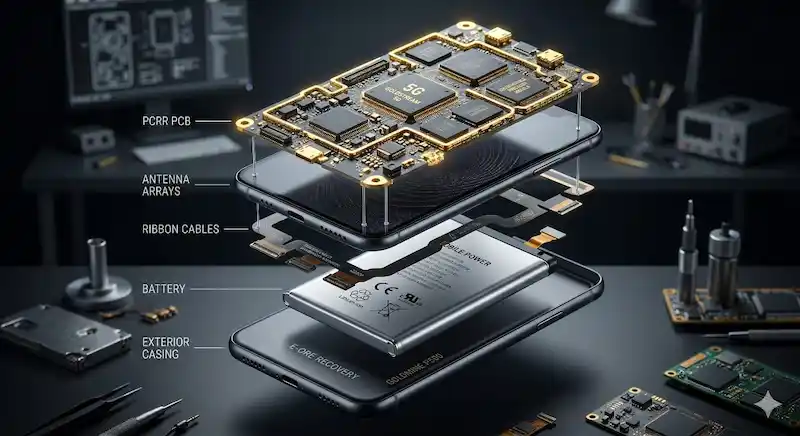
- The Motherboard (Printed Circuit Board – PCB): This is the brain of the phone and the richest source of precious metals. The PCB is covered in microchips, processors, and microscopic pathways. The connection pads, the microscopic pins on the processor chips, and the layered pathways are often plated with gold and silver.
- SIM Card and MicroSD Slots: Have you ever noticed the shiny yellow lines on the back of your SIM card? That is gold. The pins inside the phone that touch the SIM card are also gold-plated to ensure a flawless connection to your network provider.
- Connectors and Ribbon Cables: The tiny cables that connect your battery, camera module, and screen to the motherboard have ends that are flash-plated with gold to prevent signal loss.
- Capacitors and Resistors: Scattered across the motherboard, these tiny blocks contain the palladium and silver.
3. The Concept of “Urban Mining”
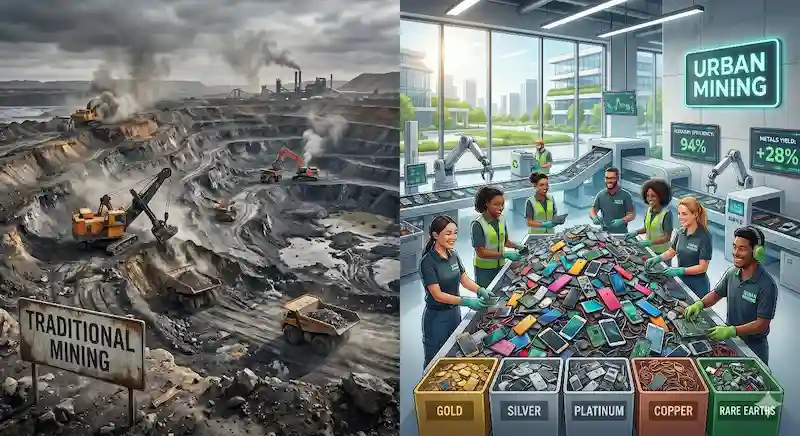
Now that we know these metals exist in mobile phone scrap, we need to understand the scale of this opportunity. Every year, millions of tons of earth are dug up, crushed, and treated with harsh chemicals in traditional mines just to extract a few ounces of gold.
But what if the richest mines in the world aren’t underground? What if they are in our city landfills and desk drawers? This realization gave birth to the concept of Urban Mining.
Urban mining is the process of extracting valuable metals and materials from electronic waste (e-waste) instead of mining them from the earth. To understand why this is revolutionary, consider this comparison:
- If you mine one ton of gold ore from the earth, you might extract about 5 to 6 grams of gold.
- If you process one ton of mobile phone scrap (which is about 6,000 phones), you can extract over 300 grams of gold!
In simple terms, mobile phone scrap is over 50 times richer in gold than the best gold ores found in nature. Furthermore, from that same ton of phones, urban miners can recover roughly 3 kilograms of silver, 100 kilograms of copper, and 100 grams of palladium.
4. The Extraction Process: How Do They Get the Gold Out?
Unlocking the Value of Mobile Phone Scrap :A common question people ask is, “Can I extract the gold from my old phones at home?” The short answer is: No, and you shouldn’t try.
Extracting precious metals from mobile phone scrap is an industrial process that requires specialized equipment, extreme heat, and highly toxic chemicals. Doing it at home is incredibly dangerous and releases poisonous fumes. Here is how professional e-waste recycling companies do it on a massive scale:
Step 1: Collection and Sorting
The first hurdle is gathering enough phones. E-waste recycling companies collect millions of discarded devices. Workers manually sort the phones, removing the batteries first. Lithium-ion batteries must be handled separately because they can easily catch fire or explode if punctured during the shredding process.
Step 2: Mechanical Shredding
Once the batteries are removed, the remaining mobile phone scrap—plastic, glass, and motherboards—is thrown into massive industrial shredders. These machines chew the phones into tiny pieces, roughly the size of a coin.
Step 3: Separation of Materials
The shredded mix is then passed through a series of sorting machines.
- Magnets pull out the iron and steel.
- Eddy currents (a type of magnetic field) repel non-ferrous metals like aluminum and copper, separating them from the plastic.
- Air blowers push away the lightweight plastics and glass dust.
What remains is a highly concentrated mix of the printed circuit boards, which hold the precious metals.
Step 4: Smelting or Chemical Refining (The Danger Zone)
To get the gold, silver, and palladium, the concentrated PCB scrap goes through intense chemical or thermal processes.
- Pyrometallurgy (Smelting): The scrap is melted in giant furnaces at temperatures exceeding 1,000°C. The plastics burn off as energy, and the metals melt into a thick liquid. They are then separated based on their different melting points and densities.
- Hydrometallurgy (Chemical Leaching): This is where it gets highly scientific. The metal scrap is bathed in powerful chemical solutions, such as Aqua Regia (a mixture of nitric acid and hydrochloric acid) or cyanide solutions. These chemicals literally dissolve the gold and silver into a liquid state. Once dissolved, specific chemicals are added to the liquid to force the pure gold or silver to drop to the bottom as a solid powder. This powder is then melted into solid, 99.9% pure gold bars.
5. The Economic and Environmental Impact
Unlocking the Value of Mobile Phone Scrap :Why go through all this trouble? Why build massive factories just to shred old phones? The answer lies in two major factors: huge financial profits and critical environmental protection.
The Financial Economics
Let’s do some simple math. If one smartphone contains roughly $1 to $1.50 worth of precious metals (fluctuating with market prices), it doesn’t sound like much. But scale is everything in the mobile phone scrap business.
According to global reports, over 1.5 billion smartphones are sold globally every year, and an almost equal number are discarded. If a recycling plant processes 1 million phones, they are looking at recovering:
- ~35 kilograms of Gold
- ~350 kilograms of Silver
- ~15 kilograms of Palladium
- ~15,000 kilograms of Copper
The combined market value of these metals from just one million phones runs into millions of dollars. Urban mining turns trash into serious cash, creating a highly profitable circular economy.
Saving the Environment
Beyond the money, recycling mobile phone scrap is essential for the survival of our planet.
- Reducing Traditional Mining: Traditional mining destroys forests, pollutes rivers, and requires immense amounts of water and fossil fuels. By getting our metals from e-waste, we drastically reduce the need to dig new holes in the earth.
- Preventing Toxic Leaks: Mobile phones don’t just contain gold; they contain toxic heavy metals like lead, mercury, and cadmium. If you throw a phone in the regular trash, it ends up in a landfill. Over time, rainwater washes over the crushed phone, carrying those toxic chemicals deep into the soil and groundwater. This poisons our drinking water and agricultural lands. Proper recycling safely neutralizes or reuses these toxic elements.
- Lowering Carbon Footprint: Processing recycled metals from e-waste produces significantly less carbon dioxide compared to mining, refining, and transporting brand-new raw materials from the earth.
6. The Challenges Facing Mobile Phone Scrap Recycling
Unlocking the Value of Mobile Phone Scrap :If recycling is so profitable and good for the planet, why aren’t all phones recycled? Despite the clear benefits, the e-waste industry faces several massive hurdles:
- The “Drawer Effect”: The biggest challenge is human behavior. Most people simply don’t throw their phones away or recycle them. They keep them in a drawer as a “backup” and eventually forget about them. Billions of dollars worth of precious metals are currently sitting idle in homes around the world.
- Lack of Awareness and Infrastructure: Many people simply do not know where or how to recycle their old electronics. While major cities have e-waste drop-off centers, rural areas often lack the infrastructure, leading people to toss phones in the regular garbage.
- The Informal Recycling Sector: In many developing nations, e-waste recycling is done informally. Workers, often without protective gear, burn circuit boards over open fires to melt the plastic and extract the copper, or they use dangerous acid baths in their backyards to get the gold. This causes severe health issues for the workers and devastating local pollution. Shifting this scrap to formal, high-tech recycling centers is an ongoing global challenge.
- Complex Phone Designs: Modern smartphones are glued tightly together to make them waterproof and slim. This makes them incredibly difficult and time-consuming for recyclers to dismantle. Batteries are strongly adhered to the casing, increasing the risk of fires during disassembly.
7. The Future of E-Waste and Precious Metals
Unlocking the Value of Mobile Phone Scrap : The electronics industry is slowly waking up to the realities of the e-waste crisis. We are beginning to see a shift toward a Circular Economy—an economic system aimed at eliminating waste and the continual use of resources.
Major tech companies are making pledges to use 100% recycled rare earth elements, gold, and tin in their new devices. Future smartphones are being designed with recycling in mind, using less toxic glue and making it easier for robots to pop out the battery and separate the motherboard in seconds.
Furthermore, advancements in green chemistry are exploring ways to extract gold and silver using eco-friendly biological solvents or soundwaves, eliminating the need for toxic cyanide and acids entirely.
Conclusion
The next time you look at a scratched, dead smartphone, don’t just see a piece of useless tech. See it for what it truly is: a masterclass in modern engineering, holding a tiny, hidden vault of gold, silver, palladium, and copper.
Unlocking the Value of Mobile Phone Scrap : Mobile phone scrap represents one of the greatest untapped resources on our planet. Urban mining is not just a fascinating scientific process; it is a vital industry that protects our environment, saves massive amounts of energy, and fuels the creation of tomorrow’s technology using the discarded items of today.
By actively choosing to hand over our old devices to certified e-waste recyclers rather than throwing them in the trash, we all play a part in this incredible circular journey—ensuring that the gold in our pockets today can be reused for generations to come.
Disclaimer: The information presented in this case study is already available across various public platforms and the internet. We are simply compiling, organizing, and presenting it here in the form of a case study for the convenience, education, and study of our readers.

Blogger Pravin
Hello, my name is Pravin, and I am a blogger and digital marketing professional. I have 5 years of experience in the IT field. I started my blogging journey in 2023. I write content on trending topics and finance, and I also work as a freelancer.
📱 The Global E-Waste Crisis: Facts & Figures
Did you know that only 20% of global e-waste is formally recycled? Explore the latest data on how mobile phone scrap impacts our environment and the massive economic potential of recovered precious metals worldwide.
View Global E-Waste Report →